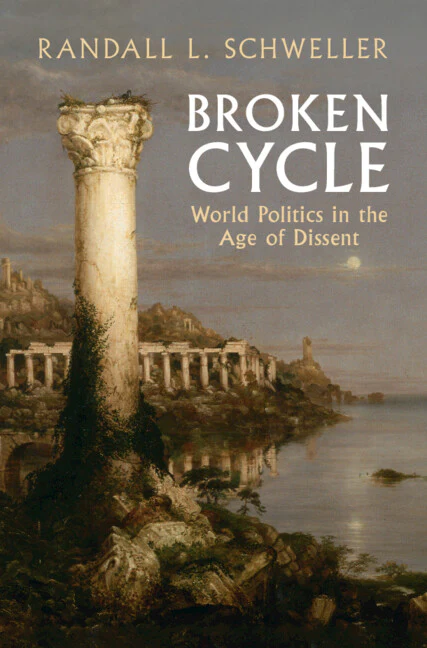
Broken Cycle
Why is the Liberal International Order unraveling – and will this lead to global disorder? Broken Cycle explores this urgent question by viewing international politics through a dynamic lens focused on the rise and fall of great powers – whose periodic global wars determine who rules and which ideas and values prevail in the reordered international system. Randall L. Schweller uncovers recurring patterns of change, offering a framework to anticipate the contours of the emerging world. Rather than tracking short-term diplomatic shifts, this book seeks the deeper rhythms of history – cycles of growth, expansion, and decline – that shape international politics over centuries. These patterns are not inevitable, but they are powerful. By understanding them, we gain insight into the forces driving today's dissent – and tomorrow's possibilities. This is a study of the structural forces that govern change, the crises that break the old order, and the ideas that rise in its place.
- Introduces the Long Cycle theory to explain patterns of global power over time, and identifies today's structural system as one of unbalanced bipolarity
- Traces the history of 500 years of international politics, from 1496 to the present, to identify the four core features shaping contemporary world politics
- Explores a “relaxed” balance-of-power system and provides a clear framework for interpreting the trajectory of Sino-American relations
Product Information
Product Information
Shipping & Returns
Shipping & Returns
Description
Why is the Liberal International Order unraveling – and will this lead to global disorder? Broken Cycle explores this urgent question by viewing international politics through a dynamic lens focused on the rise and fall of great powers – whose periodic global wars determine who rules and which ideas and values prevail in the reordered international system. Randall L. Schweller uncovers recurring patterns of change, offering a framework to anticipate the contours of the emerging world. Rather than tracking short-term diplomatic shifts, this book seeks the deeper rhythms of history – cycles of growth, expansion, and decline – that shape international politics over centuries. These patterns are not inevitable, but they are powerful. By understanding them, we gain insight into the forces driving today's dissent – and tomorrow's possibilities. This is a study of the structural forces that govern change, the crises that break the old order, and the ideas that rise in its place.
- Introduces the Long Cycle theory to explain patterns of global power over time, and identifies today's structural system as one of unbalanced bipolarity
- Traces the history of 500 years of international politics, from 1496 to the present, to identify the four core features shaping contemporary world politics
- Explores a “relaxed” balance-of-power system and provides a clear framework for interpreting the trajectory of Sino-American relations